
An Amazing Audio Illusion

Yesterday I encountered an interesting illusion online. While I’m accustomed to finding a variety of optical illusions, this one was an audio illusion. These illusions are much rarer. I saw this shared by various people on Instagram and Reddit. Here’s the illusion; I’ll provide the source below after you have a chance to listen. https://turnermagic.com/wp-content/uploads/2021/06/AudioIllusion1.mp4 If you listen to the illusion while reading the various phrases above, you can almost feel your hearing perception change to accommodate what you’re reading. This is an excellent example of how our preconceptions can and do affect our perception and judgement. SPOILER ALERT: If you’re wondering what the original phrase was, here’s a link that will tip the answer. Don’t click until you want to know what they were actually saying! https://youtu.be/5HRq9kfEy8o To learn about another kind of audio illusion, check out the Wikipedia article on “Shepard Tones,” and search them out on YouTube. Here’s a video example: https://www.youtube.com/watch?v=BzNzgsAE4F0 And finally, here’s the first video of a YouTube series collecting several audio illusions that you may wish to explore. https://www.youtube.com/watch?v=OiW8gzBGz1A
The Pursuit of Clarity on Clubhouse

Android users were welcomed to the Clubhouse audio chat app yesterday. This evening I joined a London-based room discussing the question of “Choosing Your Thoughts.” It was a discussion that drew a lot of people. Some had credible answers. Some were seeking a sort of crowd-therapy. Some were very long-winded. It was informative to me to know what not to do if I wanted to be taken seriously by the group. I decided to join in and was asked to hold on to speak near the end. Here’s what I said. Hi, I’m Joe. It’s my first time on Clubhouse. Yes, I’m an Android user! Thanks for sharing the stage. I’ve enjoyed what I’ve heard from so many so far — from Victoria, Paul, Zoe, Baiju, Allan, Marcus, and others — on the subject of choosing our thoughts. Let me be clear — I’m not really profound, and I’m no psychologist. I’ll be concise given the lateness of the hour, so I won’t elaborate on my background and career as a speaker and entertainer which you can look up in my profile, but just cut to the content I want to share about choosing our thoughts and what I’m personally learning from my own misadventures, missteps, and learning in my own life. I’m going to share a single-piece-of-paper exercise for you. First, though, I’m not sure we can always choose all of our thoughts, because we will constantly be interrupted by distractions, or challenged by temptations, or confronted by our own weaknesses. But what we can do is choose our response to our thoughts – but in order to do that, we need clarity. To choose a response, we need a way to measure and weigh options, and the only way to measure options is to have some standard. It requires a weighing, a discriminating factor to say “this and not that.” Some standard has to be set. I propose that we can pursue clarity in two facets: Clarity in Values – you can only choose your thoughts and your responses to thoughts if you have done the work of laying out what you truly value. When you know what you value – honoring God, or your marriage, and your family, and the other principles you hold in your heart. Forgive me for my “core values” corporate jargon but it’s really just a term for what is most important. Once we identify them, then we can see what thoughts and actions take us closer to that or further away from that. Take a piece of paper and make a list your top 3 or 5 or 10 or 20 things that you hold as fundamental values. Clarity of Boundaries – this is partly about understanding the triggers that put you closer to emotional paths or physical actions that don’t align with your values, but it’s also about making choices before you get to the triggers. We can choose behaviors that put our thoughts and actions at less risk of being pushed or pulled into proximity with whatever it is that draws us away from our core values. Those boundaries are good, and they are FREEING. Constraints are a boon to creativity. Artists need a canvas, and a canvas has a particular size and shape. We need constraints in our lives and those constraints free us to act and to unlock creativity the same as artists do. That’s the very, very short share about choosing thoughts, planning ahead, and taking what could be a negative and using it to make positive choices. After all there’s always a positive – as I read recently, the worst spellers have the most secure passwords. I’m Joe M. Turner, and I’m finished speaking. Thank you. [Note: Image used under this license.]
Art, Commerce, and Mistaken Premises
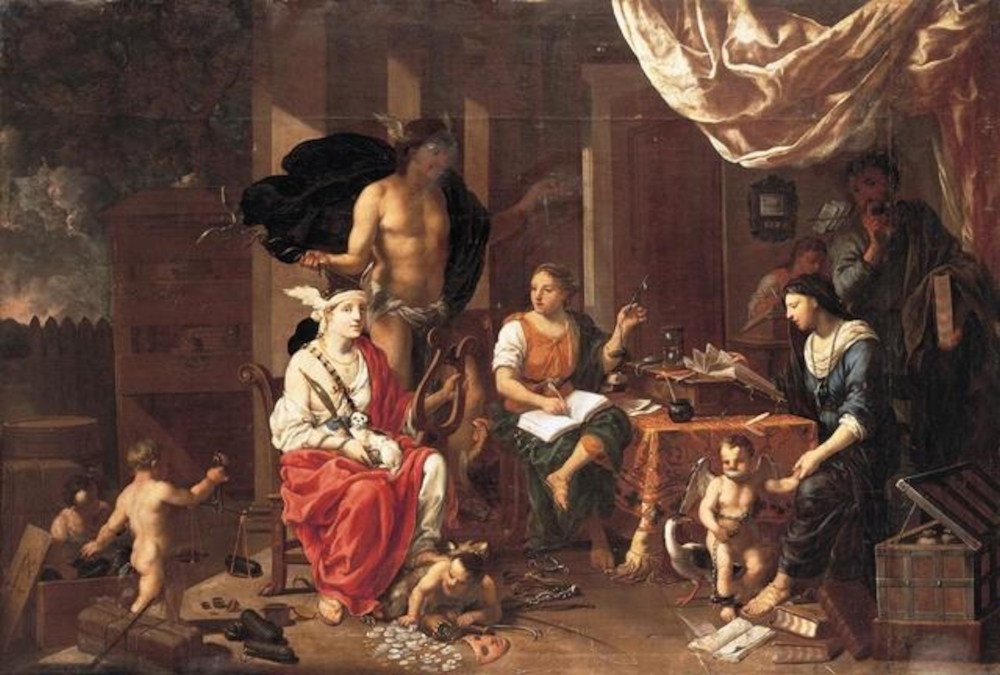
In his thought provoking and inspiring page-a-day book Secret Agenda (Hermetic Press, 2010) the great magical artist-teacher Roberto Giobbi addresses the subject of “Commerce Versus Art” with an entry for April 16 that begins with these words: Commerce is about taking. You take more money, more market shares, more work, more customers, more frequent turnover, more profit, more power, etc. Art is about giving and communicating with an audience, experiencing something unique with them. The artist shares passion, emotions and ideas. He invites the spectators to join him in his “life workshop” and shares his work with them. These lines are representative of many similar kinds of comments and assertions I’ve seen and heard from fellow performing artists over many years. The tension between meaningful artistic value and crass commercialism is a favorite topic for artists. I often agree with many of my peers about the way certain specific programs, products, or performances might be categorized. I certainly believe there are meaningful distinctions to be made in the way we attribute different kinds of value to those things. I think, however, that the way the distinction is framed above is fundamentally flawed. So I will respond with that favorite philosophical test: we must check our premises. Commerce is not about taking. The first sentence contains the first flawed premise. Commerce is not about taking. Theft is about taking. Commerce, on the other hand, is about exchanging; i.e., trading value for value in a way that benefits both parties, satisfying the desire that each of them has for something the other has. Because it allows for exchange, the meeting of need, and the satisfaction of desire without war or violence, I contend that commerce is itself a beautiful invention, a worthwhile institution, and one of the great achievements of humankind. The word begins with “com,” obviously suggesting that togetherness and interaction are in play. The rest of the word comes from “mercium,” or merchandise — or to put it even more generally, it refers to some productive output that has a shared value. To portray commerce or business as being purely about taking, or to suggest it is intrinsically an outgrowth of greed, or to frame it as inherently evil because it includes the concept of profiting from one’s productive output is not only mistaken but also reveals a blind spot on the part of the performer who is also seeking to profit, materially and/or psychologically, from his or her performances and self-expression. The producer of a business venture is compelled to express his or her creativity and drive in much the same way as the performer. The accusatory words used to describe commerce in the next sentence seem to spring from the mistaken premise that only the seller benefits from a sale. More money? One doesn’t receive more money unless one sells more items to more people who want them, or unless the item purchased is deemed to have more value by the purchaser, who wouldn’t otherwise trade their resources for it. More market share? How is it a bad thing if you have something that attracts the interest of a larger audience? Every performer wants more market share, too! More work? More customers? Neither are negative; we all seek them. More frequent turnover? This particular item in the list isn’t defined enough to critique. Turnover in staff? In inventory? In equipment? As for staff turnover, it can be argued that the only thing worse than the cost of losing a productive team member is the cost of keeping an unproductive one. In other cases staff turnover is often related to people growing beyond their current role and intentionally seeking a better opportunity, which is hardly a bad thing for the employee. If it is related to people quitting because they prefer different work, or a better wage, or even a better manager, then bring on the turnover! More power? More power to do what? To serve more people or families? To grow different lines of products or services? To express creativity through new designs, research, or manufacturing of novel solutions to problems? The idea of gaining more power to affect or influence one’s audience, environment, or circumstances isn’t intrinsically wrong or we wouldn’t teach our children to read. The question is, to what end? What is the objective of the wielder of the power? All of these things can be made negative by abuse, of course – by either workers, managers, or executives who do not treat all of the roles with the respect rightfully due to each. So also can the stage be abused by artists whose ego and aim are misguided or malevolent. But a considered review of the listed ideas reveals that none of them automatically deserves the implied scorn. Art and commerce are both about giving, communicating, and experiencing. Let’s look at the next segment, focusing on the characteristics of the artist. “Giving” and “communicating” and “experiencing” are all excellent and admirable… and they apply to the merchant or business owner as much as they do to the artist! If not, we wouldn’t have such things as departments and staff dedicated to public relations, charitable giving, marketing departments, advertising, or customer experience or employee experience initiatives — all of which are immensely important to businesses large and small all over the world. I would venture that we all know multiple business owners who make regular charitable donations to groups or organizations to which they feel a connection. I suspect nearly every business person we know has spent hours thinking about how to communicate more effectively with his or her tribe. Many business owners and leaders spend more time and resources learning to and attempting to communicate with their audiences than many performers have ever attempted! Further, I think that most business owners, operators, merchants, managers, and employees are always looking for ways for their transactions to be as mutually rewarding as that of a performer whose audience applauds with joy for the
As I Was Saying…

After Steve Allen’s departure as the first host of NBC’s The Tonight Show in early 1957, the network mistakenly tinkered around with their winning formula. Six months later they realized their error, rebooted the show, and named Jack Paar the host. Probably the most memorable thing about Paar’s tenure was the censorship kerfluffle of 1960. The network cut one of his jokes on the February 10 show; they aired news footage over it during the broadcast and failed to inform Paar of it. Paar walked off the set mid-show the next night leaving announcer Hugh Downs to finish the broadcast. Three weeks of controversy ensued, and on March 7, Parr reappeared and began his monologue with the words, “As I was saying before I was interrupted…” This comes to mind because the last post I made on this blog was just before I left to perform on a cruise ship in January/February 2020. I was performing on a ship in the South China Sea when the ports started closing around us. I boarded in Guam on February 2, and once we left port we remained at sea for about two weeks without docking anywhere. I finally got off the ship in Singapore — not even close to the prior terminating port of Taipei (which itself was a replacement for Shanghai). I got on a plane and came back to Atlanta. I spoke at and hosted a conference in Atlanta, attended a conference in Tennessee, and then came the great interruption. (As a pianist, I like to call it “The Grand Caesura.”) During the rest of the year I both did and failed to do many other things that I should. I kept active, transitioning to virtual performances and seminars which I hosted and continue to host from the studio I’ve put together here in my office. I learned to use new software tools, I learned about lighting and sound and streaming, and I worked hard to learn new ways to be interactive and effective while working in the new virtual venue. I delivered value to clients and continue to do so. But I also failed to do some things. I didn’t have a system to “keep a full pipeline.” I didn’t send out as many emails as the gurus said I should. And of course I didn’t update this blog at all. Next thing you know, it’s March 2021. Okay, fine — I’ll try to get back on the horse. I have neat things to tell you about. I have a new virtual show coming up. And I have other projects in store. Let’s see what happens.
The Magical Night the Lights Went Out in Georgia

For the last five and a half years I’ve been a producer of Atlanta Magic Night, a monthly magic, mentalism, and comedy show with a rotating cast of local and national performers. I get to perform and MC the show sometimes, but I am also one of the “on call” people if a booked performer has a problem. As it turned out, one of the performers booked for our January show contacted me to let me know he had been diagnosed with shingles. That meant that I was suddenly on the bill for Saturday, January 11. We had a pretty good pre-sale even though the weather was gloomy, so off I went to our venue partner, Atlanta’s venerable Red Light Cafe. The sky grew progressively darker as I drove there, loaded in, preset props, and did my sound check. Sure, a little rain, but everything was going just fine… until a loud crack of thunder introduced a torrential downpour. The flooded parking lot suddenly looked like a theme park flume ride. Despite the increasingly scary weather, we opened the house as people were arriving anyway, bringing news of traffic and power outages and other fun things. No worries, we had power and music and lights and food. Then, maybe 20 minutes before showtime, the entire complex went dark. Rather than panic, I went to the piano and started playing so that there was background music. I took some requests from people in the dark house. I continued to improvise and play and chat. A little after 8:00 PM, the manager asked me what we wanted to do. I suggested we give it another 30 minutes, and he agreed. I explained the situation to the people that were there. Then I also explained that rather than have them leave with no show, that we would try something unusual so even if they didn’t get a full program, they would get a really neat story to tell. We rearranged the chairs and tables to create a small performing space on the floor. People took out their phones and turned on their flashlights. And there, in a dark club, with multiple LED spotlights, I performed a close-up magic show that nobody there will ever forget. I know I won’t. One of the club’s owners is also a tech for the Atlanta Opera. She has seen hundreds of performers, performances, technical glitches, entertainers, bands, and live theatre situations. Her comment on the night? “I have no idea how you pulled that together — entertaining those people during a power outage. You pulled it off, and I’m impressed. Seriously, one of the finer things I’ve witnessed. You’re on the list!” Ellen Claire Mills Our emcee for the evening was a local attorney who does magic on the side. When he sent the photo you see here, he also shared a comment that was inspirational to me: “This was beautiful. This is what magic is about. You are a riveting performer Joe, and a connector of thoughts and people.” (Thank you, Chris!) Sometimes “stuff” happens. You either can let an unpleasant, complicated, challenging situation stop you cold, or you can let it push you to create an #amazing experience for your audience even in the midst of the storm. And that’s something useful that we can learn from the magical night the lights went out in Georgia. Epilogue We sent everyone home. I packed everything away by flashlight. As I packed the last item into my case, the power came back on. Some things are simply meant to be.
Daddy, a Star, and the Ceiling!

You might think a performer’s most treasured Christmas memories would revolve around aspects of the season related to his art. As a magician, writing about “the magic of Christmas” would not only be consistent with my brand, but also probably good fodder for a moderately shareable video. As a musician, I could spend pages writing about favorite songs and carols that cozily curl up in my ear, mind, and heart each December, or maybe I could even churn out a few chords and rhymes about reindeer and ribbons or angels and kings. Instead, my most iconic Christmas memory is an experience that happened when I was about five years old, and which might have lasted all of fifteen seconds. In the early 1970’s my family lived in a small house on a corner lot in a modest neighborhood in Jackson, Mississippi. Christmas there was rarely as snowy or picturesque as the images on Christmas cards, but my folks still committed to the traditions: food, music, and of course decorations both inside and out. Primary among the decorations was, as you’d expect, the tree. Though it is anathema to many, we were an artificial tree family. Mom and Dad liked the economics of re-using the tree year after year. I remember that old plastic pine, with wire branches that were taken from the box to be unbent and reshaped before being inserted into the pre-drilled pseudo-trunk. It was placed in the corner of the family room, to the side of the television where it would be laden with lights and ornaments and other decorations. Among those other decorations was the gaudiest tree-topping star you have ever seen. It was a hard plastic frame embedded with silver tinsel and multi-colored lights. A spring-shaped attachment at the base allowed it to slide onto the top of whatever object was destined to be its pedestal. This star was no mere ornament. It was a technological testament to the electric, blinking, polychromatic glory of post-moonshot America. I loved that star. It transfixed me. Daddy took the star out of the cardboard box and handed it to me. I held it like it was a treasure from heaven. Then he knelt down, picked me up in his arms, sat me on his shoulder and told me to put it on top of the tree. I remember the world was a blur as he stood and hoisted me into the air. I remember straining to reach over to the tree. I struggled to get the metal spring over the top, making sure it was straight and wouldn’t fall off. I couldn’t believe I was up there, so high up, looking over the sofa and the room from such an altitude, even higher than Daddy’s head. The ceiling was there and I could practically touch it. The ceiling! A moment later, Daddy set me down again and we moved on with the decorating. My head swam as I adjusted to life on the ground. It was quite a rush for a five year old. Every year after that, I wanted Daddy to hold me up and let me put the star on top again. Sometimes my brother did it, but it was usually my thing. I wanted to do it because I wanted to recapture the emotion of those few seconds that I still recall. It was always great, but never quite the same. A fleeting moment when Daddy knelt down to lift me up higher than I’d ever been, punctuated with a star. That’s what I think about at Christmas. Joe M. Turner
A Leadership Lesson from a Lousy Alarm

In the past month I’ve spoken or performed in California three times. First in San Francisco, then in Sacramento, then in Los Angeles earlier this week. I had a performance in downtown LA on Monday night, but I had to be back in Atlanta early Tuesday afternoon in order to host/MC a big corporate event at Six Flags on Tuesday night. The result of this was that I needed to take the first flight out of Los Angeles on Tuesday morning. The Monday night performance went great, and I hustled back to my hotel with an eye toward getting to bed as quickly as possible. As I got ready for bed, I used voice commands to set my alarm for 3:00 AM… so I could be at the airport by 4:00 AM for my 6:15 AM flight. Off to sleep I went! When the alarm went off I quickly got up, showered, dressed, packed, and headed downstairs. The concierge called me a cab and off to the airport I went. While sitting in the back seat, I checked my phone to get my boarding pass and to see which terminal I needed… and at that moment, I saw the time. It was only 12:45 AM! Apparently my voice command to set the alarm had gone to my tablet — which was still on Eastern time. I got up 3 hours earlier than I had planned! I had no viable choice but to go on to the airport, where I found a nice carpeted corner in the check-in area where I could doze until they started checking folks in at 4:00 AM. It’s funny now, but I assure you… it wasn’t funny in the cab! Through that minor pain, though, came a lesson I’ll take to heart: no more setting alarms via voice command for me! I’ll always check the time on multiple devices when I get up, too. But in the long run, I guess it’s better to be 3 hours early for check-in than 3 minutes late after the boarding door closes. It could certainly have been much worse. This was a relatively pain-free lesson. Competence Requires Context A useful insight I gained from this experience is this: it wasn’t my tablet’s fault that I got up early. The tablet was the picture of competence. It set off the programmed alarm completely correctly; it was “telling the truth” based on all the information that it had. The error in execution was mine, because I failed to provide the overall context needed in order to execute the task correctly. How often do we try to communicate without setting context? As a speakers, leaders, managers, communicators… are we fully considering the context into which we are sharing information? There are multiple examples of brands who published perfectly true content on their Twitter accounts, for example, but due to a tragedy or some other noteworthy event, the tone of the message turned out to be completely inappropriate. A failure to consider context can transform a perfectly accurate statement into a major misstep.
The Lasting Power of Your Personal Brand

The Lasting Power of Your Personal Brand I have written and shared many articles about the importance of your personal brand. That brand is made up of not only the work you deliver, but also the way you dress, speak, and interact with others. The power of a strong personal brand is not only that people can remember you and the work that you do, but also that you are remembered when your product or service is mentioned. I recently received an email that made me feel like some of my own efforts in this area have been successful. Hello Mr. Turner, My name is Gram Smith. You may or may not remember me because I was so little but you used to perform magic at Norcross Station Cafe in downtown Norcross, Georgia. My dad’s name is Bruce and my mom’s name is Carolee, and my sisters are Callie and Parker. My siblings and I are redheads. I just wanted to reach out and say thank you for being such a kind and friendly person to my sisters and me while we were growing up. It made our Friday nights so fun at dinner because we would always ask, “Where is Mr. Joe?” or “I hope Mr. Joe comes.” I am starting a new chapter in my life. I am now a freshman in college at Middle Tennessee State University and studying aerospace to hopefully in the future fly for Delta Air Lines. My family and I still live in Norcross. But I was just thinking about stuff I did when I was younger and I thought of going to Norcross Station for dinner and remembering you sometimes being there performing. I was watching really funny comedy and magicians earlier and remembered you. I hope all is well and may God bless you and your family. Sincerely, Gram Smith Let’s take a look at a couple of important points. 1. A good brand creates experiences that endure. It has been at least ten years since I stopped performing at the restaurant in question. So the memory of our time together has proven to be lasting for this family, both adults and children. 2. A strong brand owns the mental real estate that a customer has set aside for that industry. Did you notice what happened at the end of the young man’s note? He was reminded of me and his experiences with my magic by watching other performers. Essentially, their work made him think of my brand. That is a principle that can apply to any business, any product, any service… any brand. Consistently deliver a quality experience and your brand will not only endure, but it will benefit from the work that others do in your space. Photo Credit: These photos are used with the permission of Malika Bowling of Roamalicious.com.
Saturn, a Garage-Sale Telescope, and Your Brand

Saturn, a Garage-Sale Telescope, and Your Brand Earlier this month I was in a discussion about branding and customer experience with a group of my peers. I thought of this story from my 2012 book. I shared it and was told afterward that it made a real impact on several people in the room and how they thought about the way they deliver value to their customers. Maybe you’ll find it helpful, too. I’ll never forget the moment I first saw Saturn in a telescope. It was a 3-inch refractor that I had gotten for my tenth birthday. As I sat in the front yard I thought, “This must surely be as good as the telescope Galileo had, and he saw Saturn’s rings. I wonder…” When I saw it, I was amazed. Awestruck. I could barely believe it was real. That little dot in the sky really had a ring around it. It looked like a tiny little sculpture floating in my eyepiece. The pictures that had come back from Voyager 1 and Voyager 2 were enormous investments. The mission, the probes, the experiments, and those photos were built on the educations of hundreds of people and procured at great expense by the American taxpayer. Yet for all their costs, they had suddenly become secondary to my own personal experience through a beat-up garage sale telescope with a busted tripod leg and no finder scope. No matter how sophisticated your audience’s expectations based on other people’s reports, they will ultimately become secondary to the actual experience you deliver. It doesn’t matter how simple the delivery, as long as the experience is amazing. The photo of Saturn above can be seen in Sky & Telescope Magazine’s online gallery here. The story above is excerpted from my 2012 book High JOEltage: 101 JOElts for Becoming Amazingly Effective. The book is available on Amazon.
Dale Jr., Me, and the Power of Flexibility

Dale Jr., Me, and the Power of Flexibility Back in May, I received a Facebook message from an acquaintance I’ve known for a little over ten years. He works in the advertising and marketing industry, and he contacted me to see if I’d be interested in doing some sleight-of-hand on camera for a television commercial. Over the years I’ve done televised magic in many genres, both as a guest performer and as “magic hands.” This would be along the lines of the latter, with the camera focusing on my hands. My friend explained that the production company wanted me to send some video of my hands folding a piece of paper and magically transforming it into their product. I set up my phone and did some rough shots, and the feedback was instantly very positive. I developed a number of solutions to use magic for the spot. Then the project seemed to go radio silent. I wondered if I had done something wrong. I reached out to my contact at the production company and finally learned that there had been a change of plans and that they didn’t want to use sleight-of-hand magic to accomplish the effect in the storyboard. Naturally, I was disappointed. Then, however, I got one of the weirdest comments I’ve ever received: “The client loved your hands. Would you still be interested in being the hand model? You’d be doubling for Dale Earnhardt Jr’s hands in the commercial.” I’ve done a lot of things, but hand modeling is a new one. I figured it would be a fun adventure, so I agreed! I was asked for my ring size, shirt size, and instructed to get a professional manicure. I was told where the shoot was and where my hotel would be. Everything was scheduled to the minute. On the first day of my two-day shoot, I drove up to Charlotte. I arrived for what I was told to expect might be a 6-hour afternoon of costume fitting. I was done in less than fifteen minutes and told that they didn’t need me again until the next afternoon. The folks at Hammerhead Entertainment are extremely efficient! The next morning I took my time getting ready. I was contacted about 4 hours ahead of my original call time and asked if I could come early as they were moving faster than expected. I went in, got dressed, and pretty soon I was in front of the camera. After a few takes, though, the director stopped. The fine hair on my wrists, usually invisible, was indeed showing due to the intensely bright lights. That’s when I got the weird request that topped the earlier one: “Do you mind if we shave your wrists?” I don’t know what you do for a living, but that’s not something I hear everyday. Of course I said, “Sure, let’s do it!” I wasn’t going to get off this ride for the sake of some wispy hair on the back of my wrist! The wardrobe and make-up folks took a buzzer to my wrists and sent me back to the cameras. About an hour later I was done with the shoot, released for the day, and all set for a fantastic barbecue dinner while watching the College World Series. What did I learn from this experience? I took away a few things. First, it was fun. Realistically, hand modeling is not exactly on brand for my business. But an interesting opportunity that is one step off-brand was definitely worth the effort to be flexible. Second, I got to meet people a new and interesting company, visit another city, and build contacts that could be mutually beneficial later. Third, I got a cool story for my blog and that may also provide flavor for future speeches or scripts. Fourth, I had an amazing meal, which is a benefit that should never be ignored! Lesson Learned: Sometimes the business — and the brand — is strengthened by an event or opportunity that doesn’t seem like a perfect fit at first glance. Be flexible.
