
Memphis Magic Night Media Hits
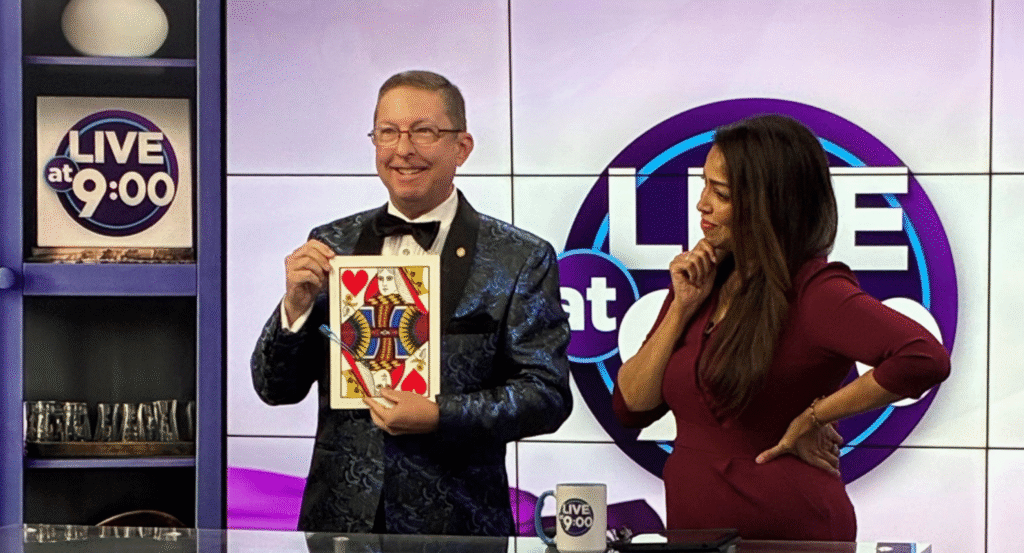
What a year! I’ve launched a new show, Memphis Magic Night, and have had multiple media hits for it and for other events. Earlier this week I made a return visit to Live at 9, the morning show on the Memphis CBS affiliate, WREG. The host Kontji Anthony gave me the opportunity not just to perform and promote my show, but also to promote the local chapter of the International Brotherhood of Magicians, Ring 16 the Society of Memphis Magicians. The full video is below. You can get tickets for this weekend’s show by clicking here.
A New Project: Memphis Magic Night

Some time after moving to the Memphis area in May 2024, I began attending local comedy open mic nights in order to scout locations and talent for a new production. That production launched in March 2025 and is now heading toward a fourth successful show. It was sparked in part by my experience as a producer for Atlanta Magic Night, which ran from 2014 until 2025. It was a great place to showcase not only my own work, but also the talents of other local performers. I knew that Memphis would benefit from something similar here, and so Memphis Magic Night was born. I have taken a somewhat different approach for this show. Rather than two magicians each month, I decided to lean into the comedy community which is already well established here. I have a different local comedian open each month with 20 minutes, then I do a full 40-50 minute act afterward. Another change to the new model is that rather than a single home location, we are rotating the show between a handful of venue partners in different parts of the city. My intent here is not to become overexposed to any single location’s clientele. Finally, I’m exploring new marketing approaches for this show. Besides social media marketing I’m using posters and flyers more intentionally. I am also exploring some additional electronic marketing. At the end of the day, though, there’s no substitute for happy audiences coming back and bringing new people with them. If you’re in the Memphis area on June 16, come enjoy the next show! Click here for tickets. In April I appeared on a local television program to promote the show. You can watch that video below.
Relocate, Reexamine, and Refocus
A little over ten months ago my wife and I relocated from Atlanta to Memphis. It was the right thing to do for lots of reasons, mostly family-related. But one major concern was how the move would affect my business. In Atlanta I had the benefit of over three decades of personal and professional networking, and moving to Memphis at this point felt a lot like starting over, albeit with a lot of lessons learned along the way. Here’s a summary of the road so far and how I tried to set myself up to be successful. Pre-Planning After we had decided to move, I scheduled some informal gatherings with local colleagues. I wanted to make sure they knew that my intent was to build new business and to respect existing client relationships. I was already aware of a few performers and their gigs in the area, and I wanted to be clear that I would not be proactively contacting people’s standing clients. In moving to a smaller city, the last thing I wanted to do was to create any animosity. Professional Networking and Local Press I had joined the local county chamber of commerce six months before we moved here. It is not a chamber with a lot of networking events, but I wanted to start building relationships with people who could help me meet people. I also sought out other networking opportunities. As a result of my first networking meeting, I scheduled an event speaking to the board of another local chamber. I arranged to speak for a fee plus a year’s membership. This led to connecting with a local magazine producer who wanted to feature my work in an article. This led to other opportunities. You can read the article in the graphic below, or download the PDF here. Further networking activities included participating in the local magic club, attending and serving at churches, attending civic events, doing free Rotary Club appearances, attending and observing comedy open mics and attending other professional networking events. Producing and Promoting My Own Appearances Attending comedy open mics was not entirely for entertainment and networking. I was also scouting possible locations to produce my own show. In the process of looking for those venues, though, I found another venue that allowed me to create additional work. The unexpected work was another restaurant gig. I had performed table-side magic at a restaurant near Atlanta for a decade, and it was extremely helpful in getting me booked for corporate events during the first part of my career. I found a venue in Collierville that was not really suitable for a parlor/stage magic show, but which was perfect for strolling restaurant magic. I scheduled a meeting, an audition, and now they want me there as many times each month as I’m available. The main project I was seeking to house, though, was a ticketed magic show in the vein of the show I had co-produced in Atlanta for the last eleven years. I found two venues and am currently seeking additional venues. Launching this show also gave me a story to pitch to local television, and that resulted in a television appearance which you can watch below. What Have I Learned So Far? While the last ten months have been a challenge, there are a number of successes, including many not mentioned here. I continue to make appearances for clients in Atlanta two to three times each month. My other clients have adjusted to flying me from Memphis, which while admittedly isn’t as convenient as the direct flights from Atlanta, has the benefit of a much less stressful entry and security process. My biggest takeaway is that there is no substitute for getting out there and making the connections happen. If you are in a business that depends on being in the right place at the right time and knowing the right people, then it follows that you need to be in a lot of places, at a lot of times, and get to know a lot of people. If I have a networking strategy, that’s probably it!
The Gig Site Dilemma:
To Bash, To Bark, To Tack, or To Have a Salad?

Those of us who have worked as independent entertainers (and industry, motivational, or inspirational keynote speakers) for the last couple of decades have seen the coming and going of a variety of services that are often referred to as “gig sites.” They may seem like a blessing to many buyers, but to the working professional they can be a curse — or at least they can sometimes seem like they’re more trouble than they’re worth. What Are These Sites? How Do They Work? The sites probably have familiar names to many: The Bash used to be GigMasters but rebranded a few years ago. Thumbtack has been around for a while, as have GigSalad and many others with the word “gig” in the title. A relative newcomer to the marketplace is Bark, which has achieved significant popularity. But virtually all of these sites exist to make money on the transaction between buyers and talent. Instead of “gig sites,” I think a more accurate term for these operations would be “lead sites.” And how you get the lead can vary from company to company, but there are three main options. One option is the free/free option — where neither the buyer nor the talent pay anything. These are few, far between, and rarely used. Considering that they generate no revenue, there’s no money to spend on promotion, so that tracks. Another option is the free/percentage option. Buyers pay nothing to search and may be contacted by multiple performers. Talent may be forced to pay a percentage of their fee by booking payment through the site, or there may be an honor system in place. This resembles the agent model in some ways. A very popular option today is the free/credit approach. Buyers again pay nothing, and their information is supplied to a limited number of providers. The interested talent has to pay a certain number of credits for the contact information. The credits required for a lead may range from two or three up to 20 or more depending on what the “lead site” decides is the value of the gig. Credits themselves can cost upwards of $2 per credit, meaning that an entertainer could pay $40 or more to send an email or leave a voice message that may never be answered or even opened. So… What’s The Good, Bad, and Ugly With These Sites? While there may be some perceived benefits, the issues with gig sites, and particularly sites using the credit option, are many. But let’s start with the positives. For the buyer, there is an obvious benefit: sites like this allow buyers to browse a lot of talent quickly. Another benefit, at least perceived as such by buyers, is that it may force some degree of competition to lower prices. (The down side to this is covered below.) For performers willing to compete on price alone, paying for every lead and being willing to undercut the market on pricing may result in a busy local calendar. But there are numerous drawbacks for buyers and for talent. Just to identify a few of them, consider: The first five people who respond to their inquiry are not necessarily the best fit for an event. They are simply the ones who happened to be checking their inbox at that moment. In most cases the rest of the talent — including the best fit for you — will never see your information. If you do request a response from a specific entertainer directly, that talent still has to pay the credits to get your contact information, and still with no idea whether they will recoup the cost. They may have been conditioned by poor response rates on that site — including from direct requests — to stop buying credits. The talent have nothing but the word of the provider that the leads they see and are asked to pay for are, in fact, legitimate leads. A consistent and increasingly expensive payment by talent to be “ghosted” by shoppers who aren’t actually ready to buy but are “just looking around at the options” feeds into the perception that the sites are not worth the money. Talent who compete on price alone are usually of lower experience and quality than performers who do not. Is There A Better Way? There is no doubt that clearing houses like Bark, The Bash, GigSalad, and Thumbtack can make it easier for buyers who are primarily price-shopping to find a lot of options that are competing primarily on price. And it’s true that some events will not be as adversely affected by a weak performance as others. But often, buyers who are producing higher-risk events find themselves browsing these sites as if they were an exhaustive catalog of “all the options.” This is easy, but it is unfortunate because there is a legitimate risk that the people you need for your event are either not on that site, or are listed but not paying for credits to spend money on price competition with lowballers. Some alternatives: Use lead/gig sites sparingly, perhaps to get a look at several options in some initial research. Do not rely on lead sites as a “one stop shop” — bios, reviews, and contact info. Look into people from multiple sources. Check out their own web sites, YouTube channels, LinkedIn profiles, Google reviews, etc. Do not rely on lead sites to make the connections you need with the best options. Instead of requesting that a performer contact you through a site, which costs the performer money even if you don’t hire them, research the performers of interest and give them a chance to interact with you directly. Bottom line: When you’re looking for the best fit for entertaining at your event, it’s risky to gamble on your entertainment by limiting your research to the few people who pay to respond to an inquiry on a gig site.
Remembering Dan Garrett (1951-2023)
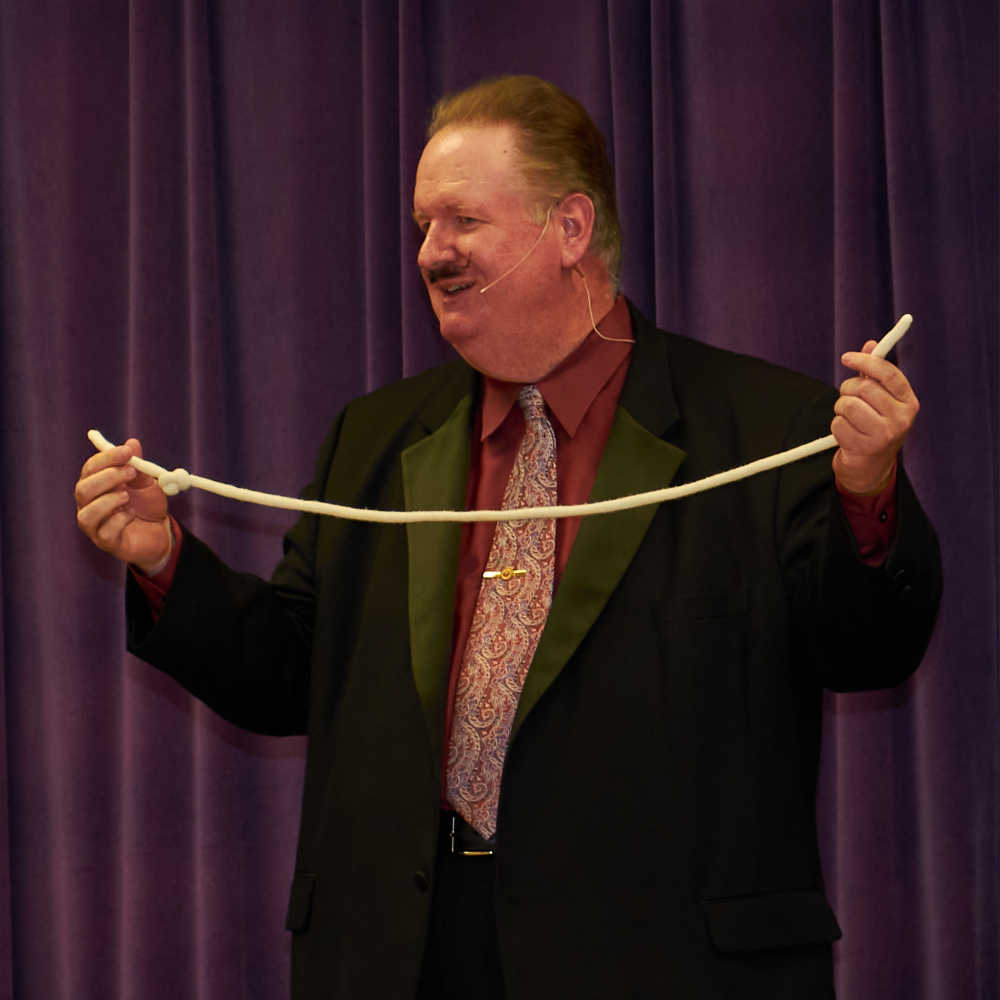
Dan Garrett’s unexpected passing from a sudden cardiac event marked both the end of a magical era in the state of Georgia and the conclusion of a career that influenced performers around the world. Daniell Edward Garrett was born in Valdosta, Georgia on September 5, 1951, and spent most of his childhood in Douglas, the county seat of Coffee County. His childhood revolved around many interests including magic, acting, schoolwork, piano lessons, playing with his kid sister Janice, and even competing in and judging 4-H Club poultry contests. In 1969 Dan’s academic prowess took him to Georgia Tech where he majored in physics and was involved with DramaTech, the student drama club. It was there that he met Dr. Charles Pecor who not only directed him in several productions but also encouraged his magical development. At the Baptist Student Union Dan met a young Georgia Baptist Hospital nursing student named Carol Jordan. Their romance would lead to marriage on April 1, 1973, just a few weeks after their respective graduations, soon after which they established a home in Decatur, Georgia. During his college years and early adulthood Dan’s magical network began to grow. His connection with Charles Pecor led him to longstanding friendships with J.C. Doty, Tom Mullica, John Miller, Bob Carver, and Duke Stern. He took private lessons from Vernon and Slydini, attended lectures and competed at conventions, and over time his career goals evolved in a magical direction. He became the store manager of M&M Magic in Forest Park, Georgia, where he worked for a decade before selling his partnership stake to perform full time. It wasn’t long before Dan became well-known throughout the magic community, lecturing and performing for generations of magicians. He wrote for and published effects in The Linking Ring, M-U-M, Genii, Apocalypse, The Trapdoor, The Minotaur, and many other publications. He published dozens of books and videos on his own magic and that of others. He became National President of the Society of American Magicians in 1994, an experience which he valued for the rest of his life. He was an MIMC in The Magic Circle and on the Board of Directors of FFFF, where he was a co-“Guest of Honor” (along with Gene Anderson) in 2005. Perhaps his favorite accolade was a quote from David Copperfield who said, “Dan Garrett has one of magic’s most entertaining and creative minds.” Dan had many noteworthy performing experiences. One was his appearance as the “Magical Burger King” at a special event at Gator Bowl Stadium in Jacksonville, Florida, where he landed midfield via helicopter. He was one of a team of magicians assembled to perform at the 2001 U.S. Presidential Inaugural Balls. And he was one of a small handful of magicians to be featured on “A Day of Magic” on CNN Headline News in 2002. In my own life, my relationship with Dan was one of mutual respect and the natural ebbs and flows of men with many overlapping interests and strong opinions. Dan performed shows that my family and I attended during different seasons of our lives, from a show as “Dan the Wizard” when my daughter was little, to an appearance at Atlanta Magic Night in more recent years. It seemed that he would always be part of the magic environment in this part of the country. It is because of Dan’s influence that many of my own magical career experiences happened at all. I was honored that his widow Carol asked me to lead Dan’s memorial service, where he was eulogized by Rolando Santos, Mark Merchant, David Ginn, me, and others. (The video of the service is linked at the web site of SAM Assembly 30, www.atlantamagicclub.com. It can be accessed directly here.) Funny, skillful, witty, and now most of all, missed. Farewell, Dan, and thank you.
Auditioning for Dr. Collins

I recently learned of the passing of Dr. Geraldine Collins, my piano professor at Mississippi State University. In discussing memories of her on Facebook and on www.gerriecollins.com, I remembered the story of how I came to be admitted to her studio in the first place. It is too long a story for a Facebook comment, but I thought it might interest enough people to post it here and share the link. Like a lot of kids, I took piano lessons as a child. We had an old piano at our house and I remember working through some basic books as a young boy in first or second grade. My grandmother had a piano at her house, too, and most of her sisters played very well; I can remember hearing those sisters singing around the piano at family gatherings. My mom played hymns with moderate ability, and her brother, my uncle, was a voice major who also knew his way around the keys. Of course it was his wife, my aunt who went on to a career as a Broadway musician and music director/conductor, who was the most expert pianist in my world. All that to say this: I was never without a pianist in my near orbit as I grew up. I took five years of formal lessons from 5th through 9th grades, and then dropped my lessons and continued to play on my own. While I had been exposed to Bach, Beethoven, Mozart, Khachaturian, Bartók, Chopin, and others in my formal lessons, the reality was that television theme songs, movie soundtracks, and Broadway show tunes were my jam. Mom and Dad got me a subscription to Sheet Music magazine and that monthly collection of pop, jazz, Broadway, novelty, and standard music was mostly what I played in high school and on into college. As a result of playing a lot of new music every month and reading those articles on theory and performance, I became rather proficient in sight-reading and even did some rudimentary composing and arranging for my own enjoyment. At Mississippi State I got involved with MSU Opera Theatre, which brought me into conversations with a lot of music education majors. I auditioned for and was cast in The Pirates of Penzance, which had me in rehearsals on a regular basis, accompanied by Jane Stewart (later Jane Stewart Hunt), a professor on the piano faculty. I remember one day before rehearsal in the spring of 1989, I was sitting at the piano in the choral hall, playing the Penzance score and going over some sections with some of the singers. Mrs. Stewart made a comment that she thought I was quite good and should consider taking some piano at State. I had seen and heard the “real” piano majors at State and knew I wasn’t in that category, but it did sound like fun. I put it off for a while, but by the late fall of 1989 I thought it would be fun to restart some lessons. I went over to the Music Ed department and asked what I would have to do in order to sign up. I remember being told that unless I wanted to go into a group beginner class, the department head would need to listen to me play and she would assign me to a studio. An appointment was made for me to visit Dr. Geraldine Collins in her studio the following week. I was told to bring something I enjoyed playing. I remember that afternoon. Dr. Collins had jet black hair and often wore dark glasses. She had a low, gravelly voice and I was thoroughly intimidated by her. I knew she was probably the musician with the most advanced training that I had ever sat alone and played for at all, much less in the context of an audition. She asked what I had brought to play, and I pulled out the vocal selections from the musical Chess, which had a piano solo that was the underscore for a scene in the show. It was written in a Russian style and had three contrasting themes. It finished with a fair amount of drama, too, which I thought would be a good thing. She told me she was unfamiliar with the show and the piece, but to go ahead. It wasn’t a technically proficient performance. I tend to fake my way through difficult passages. I have terrible to non-existent scale technique. But I do understand the music and I can “sell it.” So I played it with some gusto and tried my best to “sell it.” It was quiet for a moment when I finished. I started to feel a little embarrassed, thinking that I had perhaps humiliated myself. She waited another long moment and then said, “Well, there’s a lot to work on, but there’s a lot to work with. Joe, you’ll be studying with me personally in the spring. Sign up for a spot that fits your schedule.” That was my audition. The great Dr. Collins decided to let a showtune junkie take up a spot in her studio. In the spring she began “the work.” She dropped some Rachmaninoff on me pretty quickly, probably based on the Russian flavor of my audition. She gave me Albeniz’s Asturias, a beautiful piece that I didn’t understand at first. The Liszt Hungarian Rhapsody No. 11 was probably the most ambitious piece she ever put in front of me and I worked on it a lot. Later in life I had the opportunity to play it in Budapest, at the National Széchényi Library, after having a personal tour of some of Liszt’s own original manuscripts. Over the year that I studied with her she repeatedly tried to get me to change my major to piano performance. I resisted, to her displeasure. The piece she gave me that has meant the most to my soul is Robert Schumann’s Romance in F#, Opus 28 no. 2. This piece taught me that the
Interview with Bold Journey Magazine

A few weeks ago I completed an interview with Bold Journey magazine. Here’s the link to the full interview. https://boldjourney.com/news/meet-joe-m-turner/
The Classics Are Evergreen

I was recently booked to entertain at a conference in downtown Atlanta. My appearances took place over the course of two days. The first event was a four-hour hospitality event for about a hundred people, mostly Canadian, who worked at various companies that partnered with my client organization in some way. The next day I was brought back to entertain at a hospitality lunch for the executives of partner organizations all over the world. As the four-hour evening event on the first night was winding down, Melissa and I were conversing at a small table. I had performed for her and her colleagues earlier in the evening. “One more before we go?” she asked. I took out the cards and did a quick routine of close-up card magic that is nearly 70 years old. Magicians are very familiar with the basic plot, but it is still a glorious piece of magic. Her reaction tells the story. The classics are evergreen. They’re effective not just because they’re old, but because principles of creating human amazement are knowable and reliable and useful. (And not just for magicians.)
End Wasted Word Syndrome

Magicians aren’t the only platform presenters who suffer from WWS: Wasted Word Syndrome. This morning I saw a paid, captioned video ad from a business facilitator who began his entire pitch with what I believe are the most common wasted words in magic: “What I ______ is I _______.” In magic it’s typical to hear something like, “Now, what I want you to do now is, I want you to pick up any one of these objects and hold it behind your back.” See the wasted words? The words “what I want you to do now is, I want you to” could be completely eliminated. They could also be replaced with the single word “please” and the line would instantly become more polished as well as more “in control” and direct. “Now, please pick up any one of these objects and hold it behind your back.” The ad I saw today has this text: “I’m a ________. What I do is, I go into companies and I ______.” Can you see the wasted words? “What I do is” is unnecessary and weak. It could be eliminated completely, or replaced with the stronger word, “meaning.” I would also consider replacing “go into companies and I” with something like “help companies like yours by,” since it’s presumably an attempt to persuade. Even better, say “people like you.” Consider this:”I’m a professional facilitator. If you are leading a team, company, or association through a challenging situation, I help people like you lead their people to talk with each other more constructively and accomplish more when they meet.” For me, it might be something like this:“I’m a professional meeting host and experience consultant. If your business isn’t amazing your customers, employees, or other audiences the way it should, I equip you to think about it differently and do it more effectively.” “What I ____ is” is a giant red flag that words are being wasted. Help stop WWS! #speaking #writing #performing #grammar
Magic, Memory, and Harry

It would not be an exaggeration to say that Harry Lorayne changed my life. I first encountered Harry’s work back in high school, when I happened across a copy of The Memory Book, one of dozens of books on mnemonic memory systems that Harry wrote. I read it while on a summer vacation with my family. I learned to memorize which playing cards had been discarded in a card game; thus ended my brother’s interest in playing gin with me in the backseat. Those memory techniques went on to be a significant part of the way I studied in high school and college. I taught a seminar on those techniques while I was an undergraduate. I have done seminars, webinars, and keynotes on the subject ever since. All due to Harry. When my interest in magic had a resurgence in my late 20s, I ran into his name again. I started reading the many books he wrote on magic, especially card magic. It was strange and exciting to have learned so much from the same man in two different fields. Later on, as I became involved in magic industry associations, I had the opportunity to interact with Harry by phone, email, and ultimately in person. When I served as International President of the International Brotherhood of Magicians, I performed on the same bill as Harry at a convention in Massachusetts. I took the opportunity to present him with a Presidential Citation in honor and gratitude for his work. Harry, a high school dropout who became one of Johnny Carson’s favorite and most frequent guests, died on April 7, 2023 at age 96. His passing was marked by a significant obituary in the New York Times. I’m grateful that I had the chance to meet him, to study his work, to learn from him in person and through books and videos, and to thank him personally for his influence on me and millions of other people. Tie-Noah-Ma-Rye-Law-Shoe-Cow-Ivy-Bee-Toes. Joe and Harry. Harry lecturing. A couple of autographs. A “thinking of you” postcard I sent to Harry the week before he died. Previous Next
