
Joining the 2022 Magicians On Mission and Armed Forces Entertainment Magic & Comedy Tour
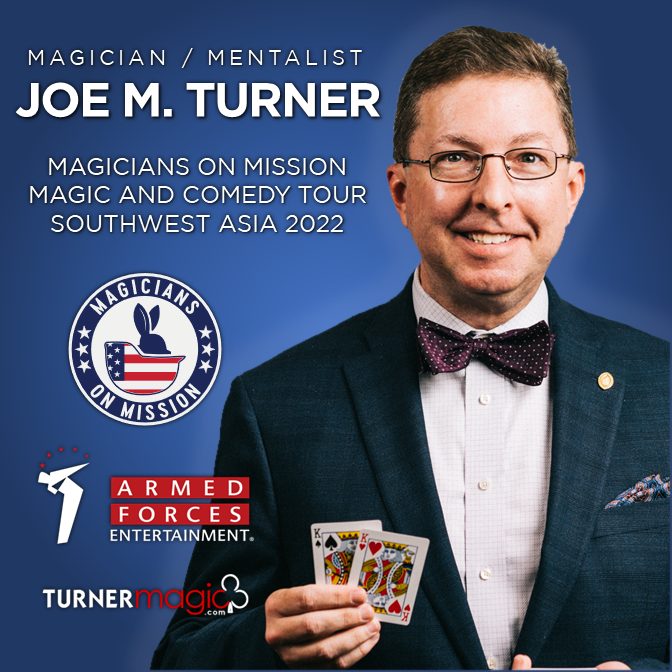
I’m honored to have been invited to join the Magicians On Mission and Armed Forces Entertainment Magic and Comedy Tour later this summer! I have hoped and prayed for an opportunity to use what I do to support and encourage our active duty military personnel deployed overseas. I’m beyond excited that this is finally going to happen! (NOTE: For security reasons, I will not be sharing the specific details of the tour locations until after we leave each base.)You can help, too! Visit www.magiciansonmission.org and click on the “Donate” option. You can make a one-time gift, or you can set up a continuing donation to become a sustaining partner. Even $5 per month would help us support one service member per year.If you know influential people, celebrities, or other people with meaningful platforms who might be interested in partnering with us, please contact me so I can introduce them to our founder, Chris Rose.Magicians On Mission is a registered 501(c)(3) non-profit organization.#magic #mentalism #magicians #mentalists #comedy #comedians #military #activeduty #armedforces #armedforcesentertainment #performingarts #supportourtroops
Atlanta Magician Turner Headlines at Florida’s Wizardz Magic Theater
Atlanta Magician Turner Headlines at Florida’s Wizardz Magic Theater This week brought a return to sunny Florida and the lovely Wizardz Magic Theatre in Kissimmee, Florida. Wizardz Magic Theater at Seralago Hotel & Suites has been presenting weekly magic from a parade of outstanding performers since August 2009. This marks the third time I’ve performed here and the first time I’ve headlined. There’s more to Wizardz than just the shows, though. Erick and Kim Olson have built this enterprise into a community that attracts both a flow of tourists and a steady cadre of magicians and local magic enthusiasts. At any given show you’ll find an audience filled with people who have never experienced live magic along with plenty of experienced magicians who are eager to see and support live magic performances in the Orlando area. Part of the fun of performing is the fellowship and camaraderie with this community. It’s always a pleasure, for example, to spend some time talking with Mary Naylor Kodell, the widow of the great stage magician Jack Kodell but also a performer in her own right. Mary was an actress in London’s West End (from the age of 12!) as well as in film and television prior to 1962, when she and Jack retired in Orlando. (You can find out more about Mary in this 2-minute video, hosted by none other than David Copperfield.) At this particular performance, the opening act of the evening was another young lady with stellar performance skills and a magical legacy. Lydia Coomes, age ten, started the evening off with a fantastic close-up act including magic with cards, coins, and even a dice-stacking demonstration! The granddaughter of magical innovator Bob Swadling certainly has a bright future in magic should she choose to pursue this branch of the performing arts. Wizardz Magic Theater was also the site of the IBM JAM in January of this year. The JAM is a members-only day of magic and learning for members of the International Brotherhood of Magicians. I admire the Olsons for their commitment to elevate both the performance and the perception of the art of magic in their community, as well as for the benefit of the IBM. They were willing to stretch past their normal processes in order to help their association be more successful. You can expect elevating performance and perception to be key themes for me as I assume the presidency of the International Brotherhood of Magicians next month. In the meantime – are you looking for ways that you can stretch and benefit your own field and your own associations? It usually takes going beyond what you’re used to doing to get different and better results!
Protecting Your Brand or Industry Image in the Media – Part 1
Protecting Your Brand or Industry Image in the Media, Part 1 A Brief Case Study, Plus Some Lessons Learned Several weeks ago an online video of a magician doing a levitation stunt in London went viral. After a brief flurry of activity, an opinion piece appeared on a targeted-audience news site in which one of their columnists cast some pretty serious accusations and aspersions on not just that performer, but all magical performers. I wrote an article in response, and somehow we both ended up on national radio. Are you ready to engage in a public conversation that may involve accusations or misconceptions about you, your brand, or your industry? If the national media calls, are you prepared to make your case in a court of public opinion? In this post and the next, I’ll share and discuss the original piece that started the discussion, my response, our subsequent radio interviews, and some of the brand management lessons I learned along the way. One quick note: While this example involves some issues of faith and religion, there are important ideas here for brand management in any arena. I rarely insert my personal beliefs into my writing or speaking, but in this case I think the events are instructive beyond that specific content. So please don’t let your agreement, disagreement or disinterest in the topic dissuade you from the value of this experience. Likewise, let’s keep any comments on this post focused on brand and media management concerns rather than any religious content. Thanks in advance. [spacer size=”60″] Tips for Protecting Your Brand Image in the Media I saw the original video of the levitation. Then, due to maintaining social media connections with a wide range of people in my industry, I saw the critical and misinformed op-ed being shared and discussed. This discussion was, as you would imagine, extremely negative. Comments on the original site became progressively more heated against my industry, while discussion among my industry colleagues became heated against many people of faith whether they agreed with the article or not. A good bit of anger and lack of understanding resulted from the original article, causing unnecessary heartache among people sympathetic to both groups. It also resulted in an exacerbated credibility gap, as the demonstrably false accusations came from a point of view that is already considered largely ignorant by a significant percentage of the industry under attack. As the discussion within my industry continued, I was contacted by a fellow performer who had a connection to the original publication. He felt that I’d be an ideal person to write a rebuttal and contacted me to ask if I’d do it. I said I’d be willing to write a response, but I’d prefer not to frame it as a “rebuttal.” He recommended me to the publication. Even when that publication called and asked me to write the piece, I declined to call it a rebuttal, preferring to eliminate or at least minimize any antagonistic connotations of the word. Instead, I looked for ways to frame my piece as simply “a contribution to the conversation.” Despite that intent, though, my first draft still had some pretty pointed criticism. After submitting the article, the editor of the publication and his staff talked with me by phone. I was asked to consider eliminating part of the article that went very directly at the credibility the publication and of the original author. I was convinced by their argument that I had made my case sufficiently without it, and that their willingness to publish my piece was a testament to their credible intent to present multiple viewpoints. They had and wanted to maintain a long-term relationship with the other writer, and frankly they wanted to protect him to some degree. If I had chosen to be obstinate or to resent input from the editors, my final piece would have had an angrier tone than I really intended. Even though the advice to cut some of it came from a source who was protecting a person whose work I was critiquing, the suggestion was correct. Legitimate, informed criticism – even from a source you don’t necessarily respect – deserves consideration. My response article was improved by my decision to take good advice. What About You? What about you? Have you had media experiences that caught you by surprise because you weren’t paying attention? Have you charged in, guns blazing, with a rebuttal instead of a response? Have you ignored good advice based on its source, and lived to regret it? What did you learn in that situation? Have you put that lesson into action since then? If so, how? In the next post I’ll continue with another 5 lessons I learned in this recent adventure, and I’ll share the audio from the interview. Stay tuned!
